
- nazramariepeterson
- May 20
- 7 min read
Updated: May 21
As women, we are told from the first time we hear about the birds and the bees: Just wait for it. Wait for the moment you turn twelve and start your period—likely at the most embarrassing moment in class. From that day on, you’re branded. You’re told you’ll turn into a "hormonal lunatic," irrational and unstable, for 5 to 7 days a month until you magically "reset."
Then the narrative shifts to: Wait until perimenopause. We’re warned we’ll lose our minds, our emotions will shatter, and our logic will vanish. We go from being screwed to screwed2.0.
For generations, we’ve been conditioned to believe that for the majority of our lives, we are destined to lose discernment and abandon our senses. We are taught that being emotional is synonymous with being illogical.
But what if 90% of that narrative is generational ignorance? What if the "missing information" isn't a mystery, but a map to you reclaiming your power? If you are tired of feeling like a passenger in your own body—if you’re ready to stop blaming the chemistry and start claiming your agency—let’s zoom in on the fine print of what’s going on in your body.
As a holistic healer based in Los Angeles, with over 80% female clientele, specializing in somatic emotional trauma release bodywork, a recurring pain point I've worked on with clients is the self-gaslighting I see many women do right in front of my eyes. Their truth is, "This relationship is draining me" while simultaneously subscribing to a narrative that's saying, "but you can ignore me because my hormones are making me irrational."
It doesn't take long to realize that the same issues and emotions that are present on the first of the month are also present every other day of the month. Let’s take a peek into my one-on-one sessions.

Trauma Release Bodywork POV: The hips don’t lie
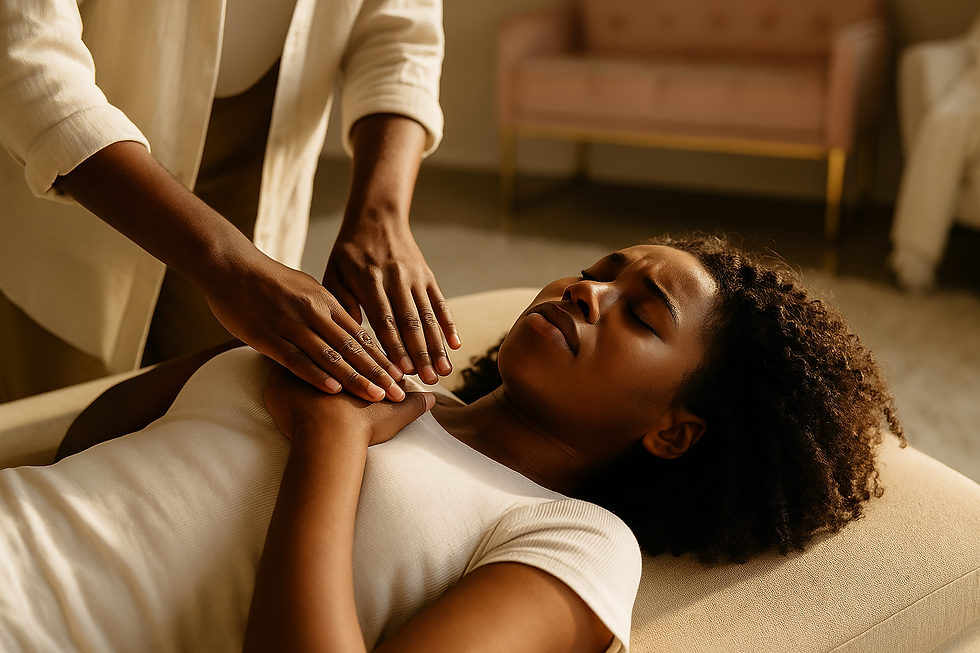
I’ve felt a lot of trauma and past experiences in my clients’ hips. I never know what I’m touching when I’m moving energy through the body. In emotional trauma release bodywork, you can feel a woman’s previous relationships and her current relationship.
As a healer, I can be touching someone’s lost love, their betrayal, someone’s miscarriage, their abortion, or their rape. I can be touching someone’s mother wound of the mother who gave them up, the one who never wanted them, who mistreated them, or the mother they were never close to. You can also feel the mom that was her best friend who passed away or the daughter diagnosed with cancer that she is terrified she's going to lose.
We carry a lot of emotions in our hips—including the energy of past sexual partners. Whether you loved them or not, you exchanged energy. The frequencies of that energy carry information: beliefs about love, inadequacy, loneliness, fear, hurt, connection, or lack thereof.

Something I’ve seen time and time again is the intensity of a psoas release. When working out the tight hips, many times women just think they’re ticklish. However, that sensation can go from giggling or hysterically laughing to uncontrollably crying in a matter of minutes or seconds.
These untold stories eventually manifest as physical messages. Your hips are talking to you through:
Irregular Flow: Heavy cycles or the total absence of a period.
Physical Pain: Debilitating cramps or clicking and popping hip joints.
Medical Pathologies: Ovarian cysts, fibroids, infertility, etc.
I’m not saying don’t look at your hormone levels; I’m saying don’t stop there. As Dr. Bessel van der Kolk says, “the body keeps the score.” Don’t bypass the emotional and energetic trauma release bodywork once you leave your OB-GYN's office.
If you live in the Los Angeles area and want to learn more about The Nazra Method for Holistic Soma Integration plans, visit the FAQs page of the website.
The Science: Hormones Are a Volume Button
Medical literature, including Early Life Trauma, Emotion Dysregulation and Hormonal Sensitivity Across Female Reproductive Life Events in NIH National Library of Medicine, states: “standard hormonal fluctuations—whether during the premenstrual phase, perimenopause, or menopause—do not inherently cause severe emotional instability on their own. Instead, unresolved trauma and Adverse Childhood Experiences (ACEs) act as the underlying catalyst, rewiring the nervous system and causing a hypersensitivity to normal biological shifts.”
Ever wonder why some women experience little to no symptoms during the menstruation or the menopausal chapters of their life while you can sometimes feel like the world is on fire and they’re sitting in front of the fireplace roasting marshmallows and daydreaming about daisies?
Well, add these two words to your vocabulary: allostatic load and differential sensitivity. You might be saying, “alo…what?” Hold on to your period panties, ladies! Allostatic load is the cumulative, systemic "wear and tear" experienced by the body and brain when exposed to chronic, repeated, or unmanaged stress. So, in plain English, I want you to look at your body as a container or vessel, whatever floats your boat. The unresolved trauma is the physical weight within it.

Trauma is more than a memory; it's a physical and energetic mass in your vessel. The more you are managing or mismanaging your mental and emotional stress on a daily basis, the more or less your body is going to notice strong emotional shifts when hormones naturally drop.
That brings us to differential sensitivity. This is also known as differential susceptibility hypothesis. When we’re susceptible, we are vulnerable to certain experiences we might otherwise not be if we’re in a more healed space.
That means certain women with less unresolved trauma have a nervous system with the physical capacity and resilience to absorb the shift when hormonal drops occur. The woman with more unresolved trauma in her body is going to feel those drops more deeply in the parts of her that are still seeking to be seen and healed by her.
But I feel better after my IUD (or HRT)

While I love that for you—because stabilizing your chemistry is a vital first step—be sure not to mistake a presentable room (your body) for a clean one. We definitely want you to feel better and have a balanced hormone system, but here’s the caveat: Remember, any hormone drops that you experienced as being “hormonal, irrational, emotional” were just disabling the mute button to your unresolved emotions.
Now that you can control the volume, many women will opt to “feel better” over addressing and healing the core issues and corresponding emotions the hormones were raising the volume to. In a society that labels people experiencing unpleasant emotions as being “hormonal and unreasonable”, the trick is not to make yourself “okay” or “fine” with the unfulfilling career, the incompatible relationship, or the strained relationship with a family member or friend.
The body is multidimensional in nature and so it needs multidimensional forms of healing to address the vastness of who we are and all of our needs. That means, while listening to your doctor and balancing out your body, don’t sweep the signals under the rug.
You can clean up the parts of your home that all of your guests can see with the naked eye. But that doesn’t mean you shove things into the junk drawers or the closet that your guests don’t see. It’s like looking at the Emotional Whistleblower, aka your hormones, and saying, “Shhhhhhh…that will be enough of you.”
The Audacity to feel Out Loud
The issues women face don't just "feel" real; they are stemming from a real place. But traditionally, women silence themselves by people-pleasing. And when you're people-pleasing you will avoid conflict, try to play the peacemaker, “look at the bright side”, suppress your anxiety and your anger until all of those emotions start to build like a pressure cooker. And like clockwork, every 28 days or so, the volume button gets turned up on these tricky little suckers called hormones, amplifying your unacknowledged and unprocessed emotions. On the outside looking in, you can look a little "emotional" aka "nuts". But on the inside, your hormones are giving you the audacity to feel out loud.
If your partner, family members, co-workers or boss lean towards disrespect or talking down to you, your hormones aren't making you angry; you're angry. When you haven't asked for that raise or promotion, it's not your period that is making you frustrated, it's the lack of speaking up for yourself that has you frustrated. It's not perimenopause or menopause making you upset about the opportunities you took for granted, the apology you never received, or the relationship you haven't taken the initiative to heal or pursue; it's you.
Now maybe you haven’t yet figured out what or why you feel angry, frustrated, sad or upset, but your hormones need to have some unresolved emotions to latch on to. Now just because you cry at a toilet paper commercial doesn’t mean you have a trauma around toilets. But the moment you saw that commercial, your hormones gave you permission to feel something that was ready to come up and come out.
It's not just in your head—it’s in your tissues, your fascia, and muscles. It’s in the knots in your back, the tightness in your neck, and the pain in your hips.
One of my favorite times of working with my female clients for their holistic bodywork, energy healing, and integration coaching sessions has always been when they complain about ‘that time of the month’ where they feel the most “hormonal”. Why is that? It just means they are feeling emotions that they haven’t identified, accepted, or fully addressed where they’re coming from. And as a healer, I am ready for the purge.
Whether you’ve done traditional talk therapy or not in the past and are curious about a journey of somatic emotional trauma release work, fill out an alignment assessment form and we will contact you for a discovery call, so you can see if we are aligned for this healing journey together.
Nazra Peterson
IG: @holistictouchbynazra